Trending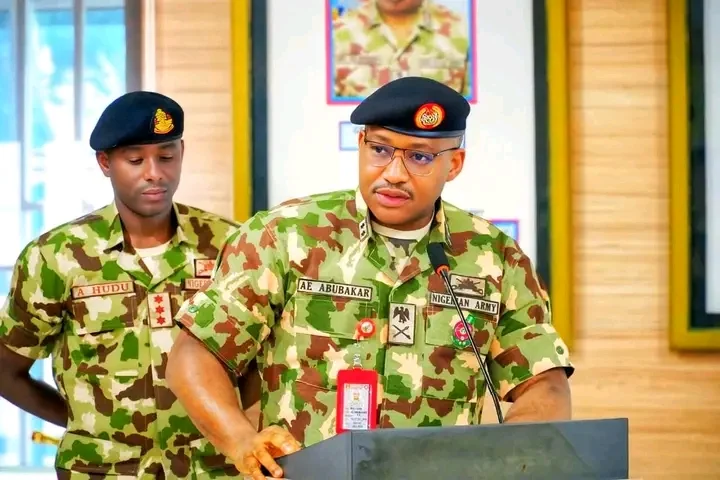
The outgoing Theatre Commander of the Joint Task Force North-East, Operation Hadin Kai, Major General Abdulsalam Abubakar, has disclosed that security forces recovered more than ₦350 million linked to suspected terrorist financiers and logistics networks during operations against Boko Haram and ISWAP in the North-East.
Abubakar made the disclosure while reviewing achievements recorded during his tenure as Theatre Commander, as he prepares to hand over following a recent reshuffle of senior Nigerian Army officers. Major General Ibikunle Ajose has been appointed to take over the command of Operation Hadin Kai.
According to the outgoing commander, targeting terrorist financing and logistics has become a critical component of the military’s counter-insurgency strategy because armed groups depend on money, fuel, food, weapons, communication equipment and supply networks to sustain their operations.
The reported recovery of more than ₦350 million therefore represents more than simply seizing cash. If the funds were indeed destined for terrorist networks, disrupting access to them could affect their ability to recruit fighters, purchase supplies, maintain logistics routes and finance attacks.
Recent military operations provide some context for that strategy. In February, troops intercepted a vehicle in Borno State and recovered approximately ₦37 million in cash and several mobile phones suspected of being connected to terrorist activities. The military said the operation was part of efforts to dismantle financial and logistical networks supporting terrorists in the region.
More recently, on September 8, troops acting on human intelligence intercepted two suspected terrorist logistics suppliers at Gumsa Bridge in Geidam Local Government Area of Yobe State. Military authorities said motorcycle spare parts and other supplies recovered during the operation were allegedly destined for Boko Haram or ISWAP elements operating around the Yunusari-Mobbar axis.
The Federal Government has also said that intelligence-led military operations have increasingly focused on terrorist leadership and logistics. In a June national-security briefing, the government reported that about 1,000 terrorist elements, including several commanders, were eliminated during the first quarter of 2026, according to figures supplied by the Theatre Commander.
Abubakar has repeatedly stressed that defeating the insurgency requires more than battlefield engagements. In July, he called for stronger and sustained intelligence sharing, arguing that Operation Hadin Kai must combine kinetic and non-kinetic measures to achieve lasting security in the North-East.
His departure comes at a critical stage of Nigeria’s long-running battle against Boko Haram and the Islamic State West Africa Province (ISWAP). Both groups have demonstrated an ability to adapt their tactics, including attacks on military positions, improvised explosive devices and increasingly sophisticated logistics networks.
That makes the financial dimension particularly important.
Killing fighters may weaken a terrorist organisation temporarily, but identifying who finances them, how money reaches them, who supplies their equipment and which commercial networks facilitate their operations could strike much deeper into the structure sustaining the insurgency.
The disclosure therefore raises an important question beyond the ₦350 million reportedly recovered:
Who are the financiers behind these funds — and will Nigerians eventually see the people funding terrorism identified, prosecuted and their entire financial networks dismantled?